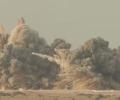
'A conventional war is not in fashion today and not seen as being able to deliver the objective.' 'Perhaps surgical strikes that are deeper, this time not on Pakistan's terrorist facilities, but on Pakistan army facilities.' 'The nation has to be prepared for losses.' 'War is not something that can be pussyfooted around.' 'If we go for limited number of posts in Kashmir, these are very difficult posts to capture and very difficult operations.' 'Be prepared for 200 to 300 killed.'

India should take steps to isolate Pakistan on the issue of killing of two jawans, one of whom was beheaded, stated the Bharatiya Janata Party on Monday. The party also urged the government to raise the issue in the United Nations and other international forums.

The talks between the two leaders covered the entire gamut of bilateral ties as well as key regional and global issues, including the Ukraine conflict.

"The fight against impunity is critical to the larger pursuit of securing peace and justice. The Security Council must send an unambiguous and unequivocal message on this count," External Affairs Minister S Jaishankar told the 15-nation UN Security Council briefing on Ukraine 'Fight against impunity'.

Considering Modi's style of practicing diplomacy, it is likely that a clear message would be conveyed to China that it is high time Beijing stops using its good relations with Pakistan as a pressure tactic against India. This is imperative not only for strengthening India-China relations at the bilateral level but also for maintaining stability at the regional level, says Sana Hashmi.

'This incident offers ammunition to those inside the US government and elsewhere who question the wisdom of trusting India, so it will have a lasting consequence no matter how it is managed.'

'While the US-Pakistan relationship has been stabilised, it's still mired in uncertainty.'

'If Indian armed forces entered Pakistan and succeeded in inflicting major damage on the Pakistani army and occupied territory in the Pakistani heartland, there is reason to think the Pakistani military would use some nuclear weapons against the incoming Indian forces to compel India to stop.'
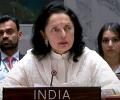
India abstained in the United Nations General Assembly on a draft resolution calling for Russia to be held accountable for violations of international law by its invasion of Ukraine and requiring Moscow to pay reparations to Kyiv for damages, loss and injury resulting from the war.
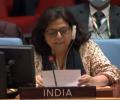
India hit back at Pakistan in the UN Security Council after Islamabad raised the Kashmir issue at the 15-nation Council.
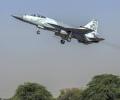
'There is hope that in the next 48 to 72 hours there will be some kind of movement forward to de-escalate and not heighten the tension.'

He said as per the US, India was a sovereign state, so "what are we then?" he asked.
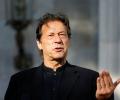
"The letter stated that the no-confidence motion was being tabled even before it was filed, which means the Opposition was in contact with them," Khan alleged in his address to the nation.

'Could the Chinese have taken a leaf out of our book?' 'That their unprecedented build-up is their attempt at coercive diplomacy with India?' 'And if so, what is it that they could be expecting as a quid pro quo?' asks Shekhar Gupta.

Russia on Monday accused the US of "actively" exploiting the "contradictions" between India and China to its advantage and asserted Moscow and New Delhi accumulated mutual trust and confidence based on decades-old ties that would help the two sides to deal with the current geopolitical turbulence.
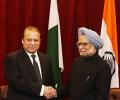
Pakistan has handed over to India a "new set of proposals" aimed at resuming the stalled bilateral dialogue and gradually addressing all longstanding issues, a media report said on Saturday.

'The two NSAs, who have been mandated to address mutual concerns on terrorism, will need to devise credible and irreversible measures to see that the likes of Hafiz Saeed and Masood Azhar do not ever get a free hand to run riot again,' says Ambassador G Parthasarathy, India's former high commissioner in Pakistan.

'We have put people on notice that if you're harbouring terrorists, be warned, be forewarned that we're going to engage with those who are providing safe haven and ask them to change what they're doing.'

The development comes after four of the eight member states -- India, Afghanistan, Bhutan and Bangladesh -- decided to pull out.

The clichd path of conducting 'uninterrupted and uninterruptable' bilateral dialogue with Pakistan to improve ties remains unimplemented and un-implementable under prevailing circumstances that are unlikely to alter in the near future, says Rahul Bedi.

The cable was reportedly sent on March 7, a day before the Opposition submitted the no-confidence motion and requisitioned a National Assembly session for voting on it.
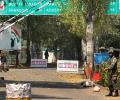
'Terrorism is merely a symptom of a deeper disease in Pakistan's body politic,' says Colonel Anil A Athale (retd).
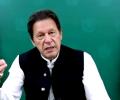
Pakistan Prime Minister Imran Khan on Friday launched the country's first-ever national security policy, which articulates a citizen-centric framework, placing economic security at its core unlike the previous one-dimensional security policy where the focus was on the military.

Pakistan Prime Minister Imran Khan on Thursday began his engagements in Moscow by laying a wreath at the Tomb of the Unknown Soldier, and is scheduled to meet Vladimir Putin, hours after the Russian president ordered a special military operation in eastern Ukraine, ignoring last-minute appeals and warnings from the West.

India on Monday blamed Pakistan for "derailing" the dialogue process but said there is "no fullstop" in diplomatic relations and people always move forward after the short pauses, indicating that there may be a window for resumption of talks in near future.
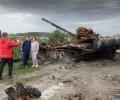
'Those who say that conventional war is a thing of the past or that war is not an option, or that diplomacy alone can prevent war -- are wrong and we see that in Ukraine.'

While some say an agreement was reached over the Panama Papers, others suggest that Nawaz Sharif may have handed the CPEC to the military in exchange for his survival.

The State Department and the White House too said that the US expects Pakistan to take decisive action against terrorists operating from its soil.
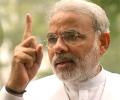
To be sure, Modi is no Vajpayee; at least that is the impression he gives. However, this doesn't mean that he will be looking for a fight. All it means is that if Pakistan seeks a fight, he will not back down. What it also means is that the pusillanimous approach of the previous governments to ceaseless provocations from Pakistan will probably change, says Sushant Sareen.

MEA spokesperson Raveesh Kumar said India rejected the repeated attempts by Turkey to justify the cross-border terrorism "practised so blatantly" by Pakistan.
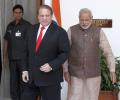
'Instead of isolation, India should respond militarily to every act of terrorism assessed to have come from across the border, unilaterally declare Pakistan a State that supports terrorism and cease all economic dealings with it.'
He, however, praised Indian High Commissioner Ajay Bisaria as a good person, but criticised the Indian government's actions.

Prime Minister Modi also made a veiled reference to China, saying the global order is based on the respect for the principles of the UN Charter, peaceful resolution of disputes, and respect for sovereignty and territorial integrity.

'Washington is telegraphing here is its willingness to support a low-grade, limited use of force meant to send a strong message to Pakistan.' 'Perhaps something along the lines of the surgical strikes in 2016, or perhaps something a bit more -- but not much more.'
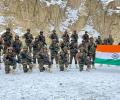
'China doesn't want to settle the boundary dispute because that gives them a reason to pick a fight with India.'

Three persons were killed and 17 others injured when Pakistani Rangers violated the ceasefire twice and heavily shelled civilian areas and border posts along the International Border in R S Pura and Arnia sectors of Jammu district on Friday, drawing retaliation from the Border Security Force.
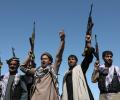
'But an overthrow of the Afghan government would really embolden regional militant groups in a big way.' 'LeT and JeM could be emboldened, and prompted to replicate in Kashmir what the Taliban did in Afghanistan.'
'To suggest that we have to take a decision on dialogue because certain countries have a certain view is showing great disrespect for Indian foreign policy,' says Foreign Secretary Kanwal Sibal.

'Since India has to live next to Pakistan, it can't remain under permanent blackmail.' 'A predictable consequence of these fundamental shifts is the fraying of the principle of strategic restraint.' 'It hasn't been junked. But the threshold has been shifted to provide India much greater room for retaliatory action,' says Shekhar Gupta.
